
Estimating God's quantum mechanical size
Is the universe unknowable?

It remains unknown who Pseudo-Dionysius really was. The 5th century mystic falsely presented himself as Dionysius the Areopagite—first bishop of Athens and Paul’s direct convert. PD is now remembered as a founding father of apophatic theology: the idea that you can speak of God only in terms of what he’s not. In his words
There is no speaking of it, nor name nor knowledge of it. […]
It is beyond assertion and denial.
Unknowability is the essence of It.
You scoff at those words maybe. We master the patterns of matter, and they appear remarkably simple. Almost everything around us is explained by electromagnetism, and electromagnetism is solved. Now we just have to tie up some loose ends. Show once and for all that spacetime is stitched together by strings, or black holes, or entanglement, or whatever.
But physical laws are stranger deities than we appreciate. We might know less about them than they about us. And to think them simple and us complex, that is conjecture—one I think Pseudo-Dionysius would bet against.
It’s no mystery why we’ve come to see the laws as simple though. The ones we’ve empirically tested really are. For example, the known laws make no reference to preferred points in space nor time. An electron’s mass could have depended on the distance from the moon or the time elapsed since Monday. But it doesn’t.
We have these miraculous cases of absent complexity, and yet, confidence in cosmic simplicity is hubris. It’s not calibrated to the big fact.
How much do we know?
When we aim our telescopes at the dotted dark, we see many familiar objects. Understanding them in detail is hard work assigned to the astronomy department, but we’re confident in the handful of elementary rules. So the stars, planets, and their relatives—these are rightfully said to be governed by simple laws.1
But how much of the universe is this? The answer is best quantified using entropy. Entropy is defined as the amount of surprise you expect when you observe something in complete detail. In practical terms, if you had an oracle answering any yes/no question truthfully and correctly, an entropic thing would require you to ask many questions before you had complete knowledge of it. Something highly entropic requires a large amount of information to describe fully. Simple things do not surprise.
Our best estimates indicate that black holes carry hundreds of trillions of times more entropy than all the normal stuff combined. And yet, even the black holes are a rounding error in the total sum. Compare a bathtub of water to the full ocean itself. That’s how large a fraction of the entropy of the universe is contained in black holes. And the stuff we actually understand is a hundred-trillionth of that bathtub.
What exactly holds the vast majority of potential for surprise, nobody knows. You should find that counterintuitive since I present you with a concrete number. But this situation is not without precedent. In the early days of thermodynamics, you could compute the entropy of a canister of gas without understanding what kind of surprise would show up if you looked closely. Today we know it’s represented by the configuration of individual molecules. Specifically, in their positions, velocities, rotations, and vibrations.
So we know how to decompose the entropy of gases, but for the full universe we do not. We just know that if we take core principles of physics and extrapolate them to unmeasured regimes in the most parsimonious way, then we are led to this conclusion:2 the total entropy of the observable universe is given by the area of the cosmic event horizon.3 The cosmic event horizon is the surface beyond which we can never receive signals due to the accelerated expansion of the universe.
The computation of this formula does not explain much, however. It does not reveal a decomposition of the entropy into microscopic understood components, in the same way thermodynamic computations in the 19th century did not reveal the identity of atoms beyond their aggregated capability for surprise.
So for the universe as a whole, all we know is that the unknown is vast. This sea of surprise isn’t hidden away somewhere far away from Earth. It’s here, around—although it might not be properly localized in space at all. We don’t even know whether “here” and “there”—and possibly even causality—are concepts that survive when you try to look at these… entities.
How much can we ever know?
The above is only the beginning, however. Opting for parsimony, let’s assume that a unified quantum theory including gravity can be found that describes the universe as a whole (we silently assumed this above already). Then we have a clean separation of physics into two parts: the state of the universe and the laws evolving it forward in time. The surprise discussed above is the latent surprise in the state of the universe, not in the laws.
What about the laws themselves? What room for surprise do they carry? In quantum mechanics, the universe’s state is described as a list of numbers while the laws are described as an array of numbers:
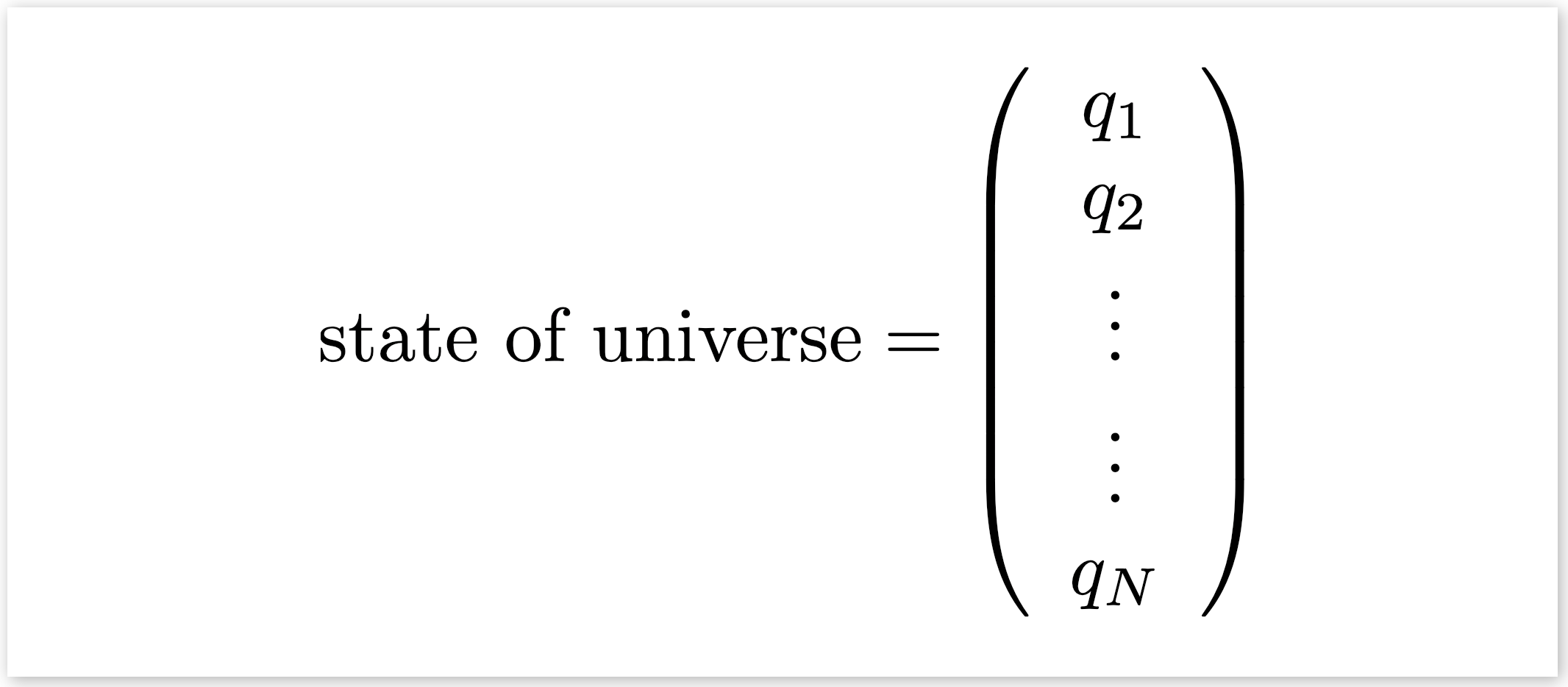
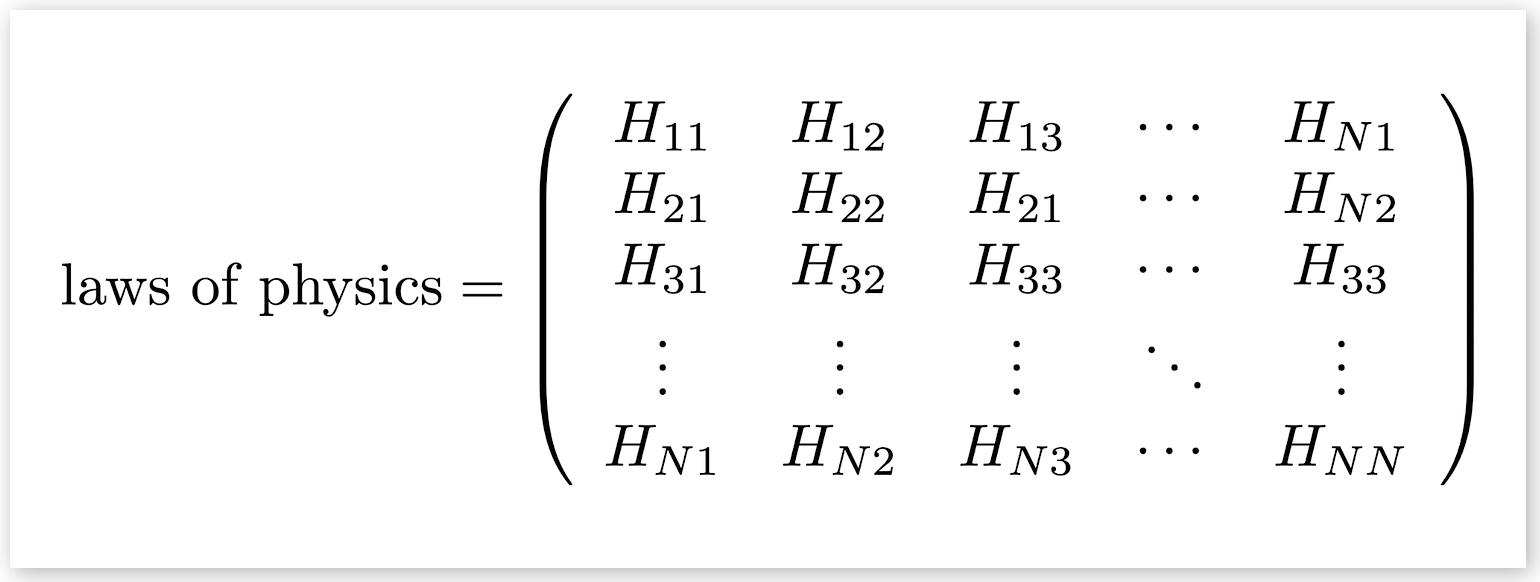
To write down the list is to specify the state of the universe. To write down the array, known as the Hamiltonian, is to fix the laws.
Restricting to the observable universe only, our estimates of the entropy translate to N equalling about 10^(10^122).4 That is, the length of the list describing the state of our observable universe is an exponential raised to a number with 123 figures or so.
As large as that is, it’s a tiny number relatively speaking. The laws furnish an N-by-N array, so the number of elements you need to write down to fully specify the Hamiltonian ends up being the square of the former number. That is, the count of independent numbers describing the laws is 10^(10^122) times bigger than the total count of numbers describing the state.5
Language can’t quite get a grasp here, but it’s safe to say that the space of possible physical laws in quantum mechanics is big. However, the physicist’s hope is that the Hamiltonian is nice—that most of the numbers are zero or redundant. And we do know that many of them are. No action-at-a-distance zeros out many, while independence of the laws on position sets a bunch to be equal to each other. Basically, it says that the array looks something like this:
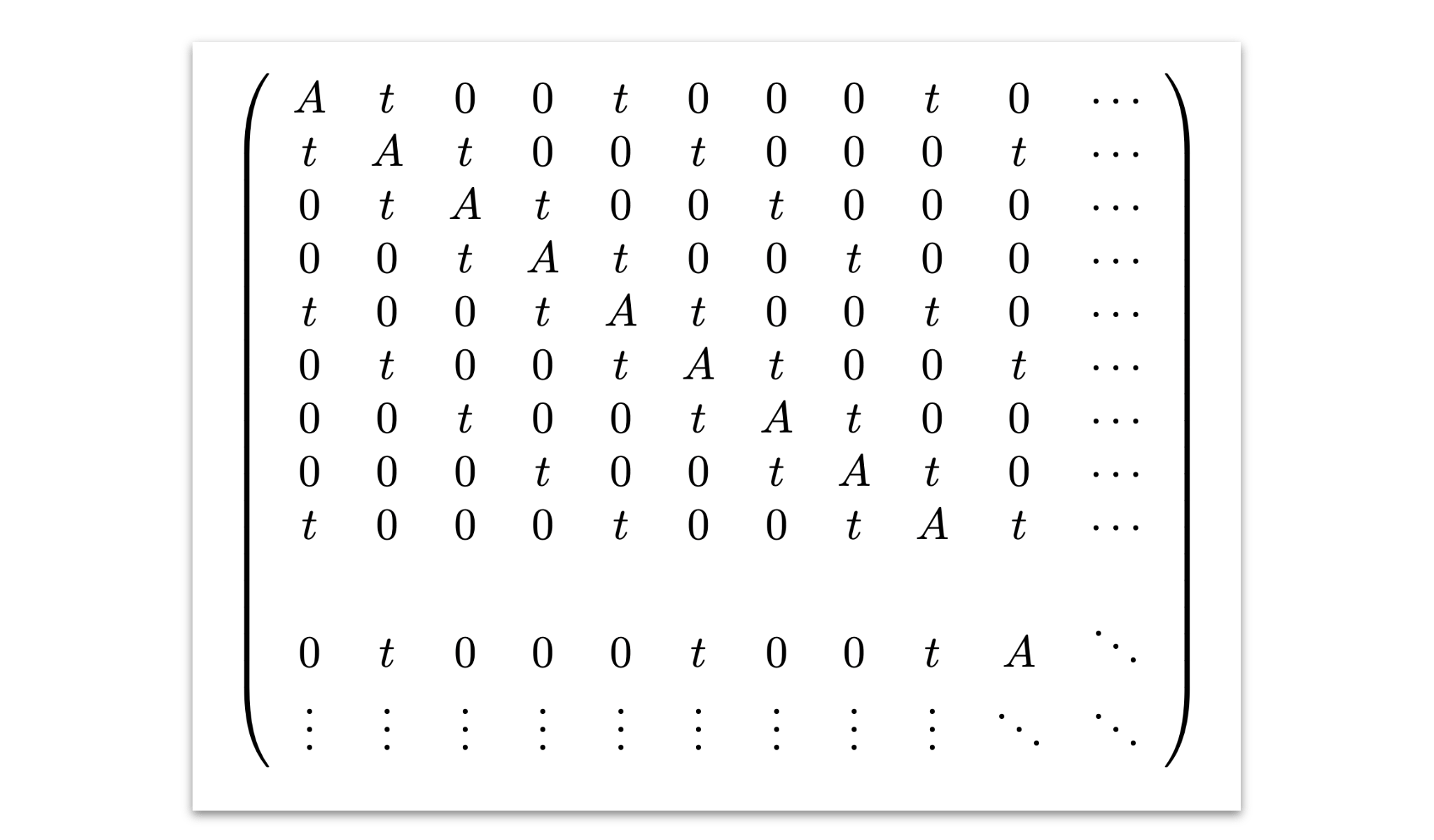
But we’ve only tested these simplifying properties in a little droplet of the universe. We’ve only seen a tiny little corner of the matrix. The universe hides behind the “…”s.
So, all we know for sure is that a negligible fraction of the elements of the Hamiltonian array simplifies. Only those numbers that directly determine the behavior at sufficiently large times and distances (and at sufficiently low complexity6).
This leaves open a strange possibility. The big fact.
Compare a length N list with an array of size N-by-N. When N is large, the array can carry vastly more information. So unless the array has a lot of redundancy, the information it carries cannot be stored in the list. The consequence is that the following is consistent with quantum mechanics and our experimentally validated physics:7
The laws of physics are too complex to fit inside the observable universe. We can never known them exactly.
This Pseudo-Dionysian universe is one with phenomena that can be experienced, but which cannot be explained. Records without causes. Or rather, causes so complex they cannot be written down, even with all of the observable universe’s matter at your disposal to build a hard drive. I dubbed these untheorizable phenomena Spirits here:

Spirits are animated by a hand operating from a shadow immune to illumination. A hand whose description demands answer to a number of questions so large that all matter in the visible universe would not constitute sufficient material for representation.
Is it likely that this is our universe? You can say we’ve only seen simple laws, so they will probably stay simple as we keep looking. But most likely and likely are completely different propositions. How confident can you be in your knowledge of the ocean when you have not even seen a droplet?
The reasoning from the previous paragraph applies to this whole essay as well. It is hubris. It is overconfidence. Sure, quantum mechanics is the most likely final theory; we haven’t seen a violation yet. But is it likely? Does it remain a good theory as you roam the depths? All other laws of physics have either broken down, or are expected to stop making sense, once pushed far enough. Are you willing to bet that the axioms of quantum mechanics are different? And if quantum mechanics dies before you get to the hypothesized regime of quantum gravity, where does that leave us?
I don’t know.
Provided you do not ask too intricate questions about said objects—see Spirits and the Incompleteness of Physics for more in this caveat. It’s a deep one.
Or, to be more precise, the part of the universe that can ever be visible to us even in the far future. An approximately de Sitter causal diamond.
This assume that the size of the Hilbert space describing our causal diamond is of order e^{S_{cosmic horizon}}. This is a widely held assumption, but you can try to wriggle out of it by distrusting that Euclidean gravitational path integrals really compute fine grained von Neumann entropies. This is a difficult position to hold. You will have to dispute black hole thermodynamics.
Let’s be slightly more precise. The Hamiltonian matrix has redundancies. The numbers above the diagonal are completely specified from the ones’ below the diagonal. Furthermore, while each diagonal element is a real number, each element above/below the diagonal is a complex number, meaning it is represented by two standard real numbers. Now, there are N^2 array slots in total and N on the diagonal. Thus, subtracting the diagonal, there are N^2 - N off-diagonal numbers. Only half of them are independent, i.e. (N^2-N)/2. But those are complex numbers, so we multiply by two to get the number of independent real numbers, getting the count of N^2 - N off-diagonal elements. Adding back in the N real numbers on the diagonal, we get N^2.
See Spirits and the Incompleteness of Physics for a discussion.
This counting argument seems naive, and the argument in the main text does not account for how well we can approximately learn the laws from inside the universe. But it is essentially right. You can formalize this, although writing it up would make this a full physics paper.
"Spirits are animated by a hand operating from a shadow immune to illumination. A hand whose description demands answer to a number of questions so large that all matter in the visible universe would not constitute sufficient material for representation.
Is it likely that this is our universe?"
Anecdotally. Personally. This lines up pretty well with my own experience of my self. I seem to be living in a story that could never possibly be written down in its entirety, yet it is as complete as anything can be.
Always great stuff